
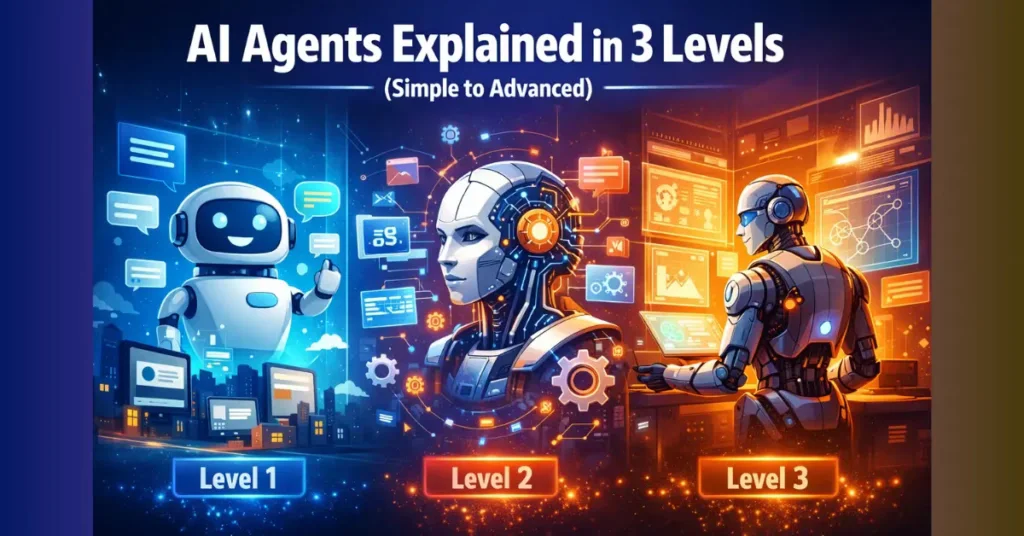
AI Agents Explained — that phrase is suddenly everywhere. In tech blogs, conference talks, product roadmaps, and even casual conversations between developers. A few years ago, we were impressed when a chatbot simply replied with, “Hello, how can I help you today?” Now, we watch software plan tasks, make decisions, talk to tools, correct itself, and continue working without us clicking a single button.
Somewhere between those two moments, a quiet but powerful shift happened.
That shift is what we now call AI agents.
The challenge is that most explanations don’t really help. Some articles oversimplify the idea so much that it feels meaningless. Others go so deep into research language that you’re lost halfway through the first paragraph. If you’re a developer, tester, product thinker, or just someone curious about where technology is heading, that gap can feel frustrating.
So let’s slow things down and talk like humans.
In this blog, I’ll walk you through AI agents explained in three clear levels of difficulty. No hype. No unnecessary jargon. Just a practical, story-driven explanation—starting from the basics and moving toward real-world production systems.
By the end, you’ll not only understand what AI agents are, but also how they evolve, how teams build them, and why they’re quietly reshaping modern software.
AI Agents Explained at Level 1: From Chatbots to Agents
Let’s start simple. Very simple.
Most of us have interacted with chatbots.
Customer support bots. Website help widgets. Even basic AI assistants.
A chatbot usually works like this:
- You ask a question
- It responds
- Conversation ends unless you type again
That’s it.
Now here’s the key difference.
An AI agent doesn’t just respond.
It acts.
Think of a chatbot as someone answering questions at a desk.
An AI agent is more like an assistant who:
- Listens to your request
- Thinks about the steps
- Uses tools
- Checks results
- Adjusts if something goes wrong
All without you telling it every tiny step.
A Simple Real-Life Example
Imagine you say:
“Find me the cheapest flight to Bangalore next week and notify me.”
A chatbot might reply:
“Please visit a flight booking website.”
An AI agent would:
- Search flight data
- Compare prices
- Filter dates
- Pick the best option
- Send you a message
That shift—from answering to doing—is the heart of AI agents.
At Level 1, an AI agent is:
- Goal-aware
- Context-aware
- Able to perform basic actions
It still feels simple. But under the hood, something important has changed.
AI Agents Explained at Level 2: Building Them in Practice
Now let’s go one layer deeper.
This is where things start getting interesting—and slightly messy, like real software development.
At this level, an AI agent is usually made of four core parts (even if they’re not named that way):
- A Brain
This is the AI model that understands language and intent. Many teams use models from platforms like OpenAI here. - Memory
Not human memory—but enough to remember:- Previous steps
- User preferences
- What worked or failed
- Tools
APIs, databases, browsers, calculators, test systems—whatever the agent needs to actually do something. - Decision Logic
This decides:- What to do next
- Whether a task is complete
- If something needs retrying
This is the point where agents stop being “cool demos” and start becoming useful.
A Practical Scenario
Let’s say you’re building an AI agent for software testing (something close to many teams today).
You tell the agent:
“Run regression tests for the payment module and summarize failures.”
The agent might:
- Pull test cases
- Execute tests
- Analyze logs
- Group failures
- Highlight patterns
- Generate a summary
No single step is magical.
But the coordination of steps is what makes it powerful.
Frameworks like LangChain became popular exactly because they help developers wire these parts together without reinventing everything.
At Level 2, AI agents feel like junior engineers.
They’re not perfect.
They need supervision.
But they save a lot of time.
AI Agents Explained at Level 3: Production Systems
This is where the conversation shifts from experiments to responsibility.
In production, AI agents are no longer toys. They:
- Handle real users
- Touch real data
- Make decisions that matter
And suddenly, new questions appear.
What if the agent makes the wrong decision?
What if it loops endlessly?
What if it accesses something it shouldn’t?
What Changes at This Level?
At Level 3, AI agents become part of systems, not standalone tools.
That means:
- Monitoring
- Logging
- Guardrails
- Human override mechanisms
- Security checks
- Cost controls
Companies deploying agentic systems usually add:
- Approval steps for risky actions
- Limits on tool access
- Fallback logic
- Clear audit trails
An example you might not notice:
Customer support agents that resolve tickets automatically, escalate only complex ones, and learn from outcomes over time.
Another example:
Internal enterprise agents that:
- Prepare reports
- Analyze metrics
- Notify leadership
- Trigger workflows
These agents don’t just “chat”.
They participate in business processes.
At this stage, AI agents stop feeling like software features and start feeling like digital coworkers.
Not perfect coworkers.
But helpful ones.
OpenAI
Summary
Let’s zoom out for a second.
AI agents aren’t a single thing. They’re a spectrum.
- Level 1 showed us the shift from chatbots to action
- Level 2 revealed how agents are built in real projects
- Level 3 showed what happens when agents run in the real world
Understanding these levels helps you:
- Learn without feeling overwhelmed
- Build without overengineering
- Adopt without unnecessary fear
Conclusion
AI agents are not science fiction anymore.
They’re not “someday tech”.
They’re here. Quietly. Gradually. Everywhere.
And the most interesting part?
You don’t need to be an AI researcher to understand them.
Once you break them down—layer by layer—they start to feel surprisingly logical. Almost obvious.
If you’re in tech, learning how AI agents work is no longer optional.
If you’re building products, they’ll shape how your users interact.
If you’re just curious, they offer a glimpse into how software is becoming less reactive and more… thoughtful.
And honestly?
We’re just getting started.
FAQs
What is an AI agent in simple terms?
An AI agent is a system that can understand a goal, decide steps, use tools, and act independently—rather than just replying like a chatbot.
Are AI agents the same as chatbots?
No. Chatbots respond to messages. AI agents can plan, execute tasks, and adjust actions based on outcomes.
Do AI agents replace humans?
Not really. They assist, automate repetitive work, and support decision-making—but humans still guide and control them.
Can beginners learn AI agents?
Yes. Starting with simple concepts and small projects makes AI agents approachable, even without deep AI knowledge.
Are AI agents used in real companies today?
Absolutely. Many companies already use AI agents for support, analytics, testing, operations, and internal automation.
Explore More Posts Here – TOPICS

