
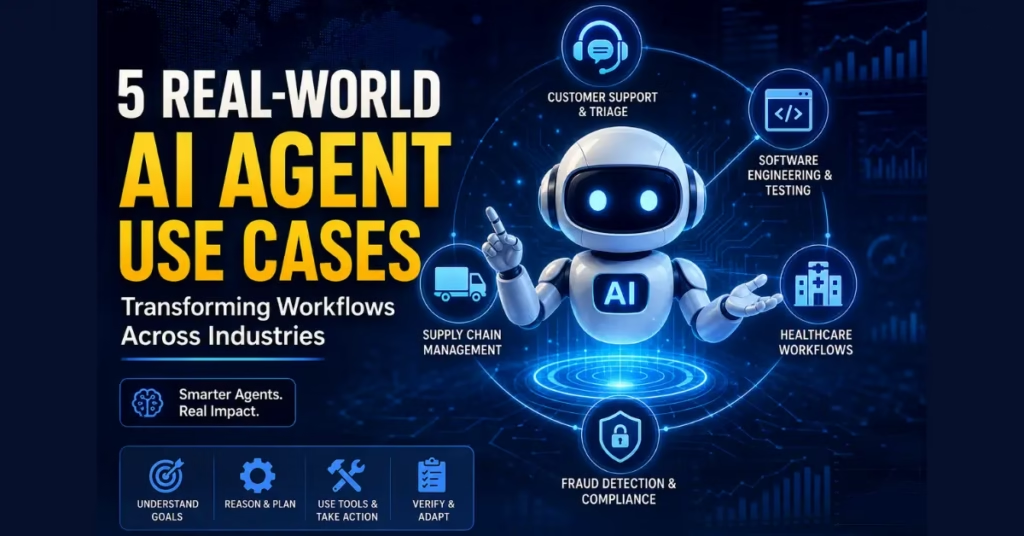
AI agent usage cases are more and more relevant as organizations want to leverage artificial intelligence beyond plain chatbots and content generation.
Artificial intelligence is changing quickly. Not long ago, people used AI mainly for questions, content generation or information summarization. The discussion today is progressing toward something more functional: task-doing AI agents.
An AI agent can comprehend a goal,reason through several steps, leverage tools that are connected, speak on information gathered from experiences and take actions accordingly. This differentiates it from a classic chatbot that generally responds to a question.
From customer service and software auscultation to healthcare, supply chains, and fraud detection businesses are now making practical on AI agents.
For this article, let us explore five real-world Ai agent use cases that are revolutionizing industry-specific work around the globe.
Automating End-to-End Customer Support and Triage
One of the clearest use case is customer support.
Consider the situation where a Customer calls saying : “My payment got failed but money was debited.
For instance, a simple chatbot would give general responses. A complete AI agent could do so much more. It can recognize the customer, verify a transaction, check account history, review company policies, create/update a support ticket and determine if the problem is resolvable through automation or should be routed to a human agent.
This is where the usefulness of AI agents comes in.
They can potentially push the whole workflow instead of merely replying to inquiries.
This could cut down on a lot of the repetitive work for support teams when it comes to simple requests! In rare or delicate circumstances, the agent can elevate to a human with the information already gathered.
AI agents are systems that can reason and take actions to achieve a goal using functionality. Google Cloud AI Agents
This doesn’t mean taking humans out of the customer service equation. It is to have people spend more time on cases that require real human judgment.
Accelerating Software Engineering and Testing
AI agents might become especially fascinating for software teams.
There is a lot more to software development than just writing code. Developers, testers should understand requirements; you write test scenarios, make automation, investigate failures and changes; you review and documents the result as well.
Some of these steps can be aided by AI agents.
For instance, if the title is password-reset feature, an AI agent could spot Lesson: positive and negative scenarios to cover a test casePrepare test dataHelp we create automation scripts
A different agent may parse failed tests and summarize potential reasons.
This, in turn, closely relates to multi-agent AI — where agents handle specific domains. You could refer existing article on multi-agent making it an internal resource for readers who wish to dive into this idea.
But there is a significant caveat: generated code and generated tests still need review by humans.
The role of a tester may become less writing each test by hand and more assessing whether AI has detected the correct risks and situations.
That might even inject interest into testing rather than minimise its value.
Orchestrating Adaptive Supply Chains
Supply chains never work exactly as you would think.
A supplier can face a delay. Demand can suddenly increase. Transportation can be disrupted. They could have their biggest product sitting in a warehouse out of stock.
Automation — which in its conventional mind is process automation created on pre-established rules. An AI agent is similar to someone who goes with the flow, examining partial information informally referred to as wisps and selecting a next step that can be rationalized.
For example, an inventory agent identifies a spike in the sales of one product.
It is capable of analysing existing stock, what suppliers have available and what has been scheduled and delivered. Depending on company practices it may suggest relocating inventory between the warehouses or even contacting the vendor.
Well, duh — not just automation either.
It is adaptability.
But what the hell do agentic workflows even mean AIs that can emote how to you really expect me to believe a bot will tell me how it is feeling And then, alter its responses based on changes in the environment? Google Cloud: Agentic Workflows
Still, businesses need controls. While it is one thing to give an order which a signal is shot through the wire by some AI agent — entirely another for this same AI agent to autonomously hit a large purchase order.
Streamlining Clinical Triage and Healthcare Workflows
A sector for which AI agents seem like another opportunity to reduce drudgery is healthcare, but that will need a lot more stringent protections.
The healthcare industry is a highly data-driven industry in which hospitals and healthcare organizations need to handle appointments, patient informations, reports, insurance documents claims and many other administrative processes.
An AI agent could help consolidate information to identify appropriate info, triage requests and condition data for healthcare professionals.
Instead of a staff member manually reviewing hundreds of documents, for instance, an AI system could do all the preliminary legwork and flag individuals that truly deserve a closer look.
Microsoft has pointed to healthcare scenarios in which AI agents assist by processing and validating claims-related documents, with human experts managing exceptions. Microsoft Bajaj Health AI-First Customer Story
That is the likely correct way to think about AI in health: AI does routine info work while qualified humans remain responsible for significant decisions.
Healthcare is just too sensitive for anything to be left without adequate human oversight.
Scaling Anti-Money Laundering and Fraud Detection
Current systems for detecting suspicious transactions already look advanced.
Detecting suspicious transactions on its own is just a beginning.
From there, an investigator might have to dig through transaction history, customer details, past alerts and other activity.
One way this investigation might be aided is through an AI agent.
It might pull data from authorized systems, seek out anomalies, organize corroborating documents and draft a report for a compliance officer.
That might eliminated the investigative crwling part working itself.
However, for financial crime detection to be effective, accountability is required. AI agents should work within no-notice permissions, with strong oversight, audit trails and human approval for high-risk decisions.
The point is not to turn all compliance decisions over to AI.
It is to allow analysts to process more and comprehensive information while directing their focus where it matters most.
Why AI Agent Use Cases Matter
Flexibility is the biggest factor separating traditional automation from AI agents.
Automation of traditional kind works, say like this:
If A happens → do B.
Instead a more intelligent AI agent is expected to work more like this:
Know the purpose → see the context → decide what is next step → apply whatever tools you have available → check if it worked —> proceed or escalate
That is a significant change.
The fourth factor takes into account both why companies should consider the trade offs of security and testing data access and governance before opening up too much freedom to such agents.
This change should be watched closely by all technology professionals. Affecting just developers or data scientists, AI will not pass you by. It can alter the way in which testers, business analysts, support teams, and many other specifications conduct their day to day tasks.
You may also be interested in reading our related post: AI and the Human Workforce – How these changes will affect the future workplace.
Conclusion
With the arrival of AI agents, artificial intelligence is now a step beyond answering questions to doing things.
Customer support agents can find it useful as well to check whether they may fix it or other existing/procedural problems. The software agents help in a development testing scenario. Instead, you draw up the state and condition of a supply-chain agents. Administrative workload burden can be lowered with healthcare agents. Sustainable financial investigators can support suspicious activity
This is not over and done with, the technology still needs time to develop.
It might not be the companies that give AI free reign that finds most success. They will discern what workflows are ideal, provide clean data, create guardrails, and allow humans to retain the option to make judgments.
Finding that balance may make up the next chapter of enterprise AI.
FAQs
What are AI agents?
AI agents are a type of software system that is able to comprehend goals, reason about tasks, employ tools and act with some degree of autonomy.
The Key AI Agent Use Cases
Common avenues include customer support, software development and testing, supply-chain management, healthcare workflows and fraud detection and compliance.
Can AI agents replace employees?
AI agents may automate portions of many jobs, especially repetitive work. That said, there are some things that only humans can really do (for now): Like analyze data and create intelligence; communicate honestly and credibly; keep humans accountable.
An AI Agent – can you use it in software testing?
Yes. They help in test-case generation, test-data creation, automation, failure analysis and test reporting. Ensure results covered business-risk, which needs to be validated both on automated and Human Testers
Are AI Agents Safe for Business?
And they can be, if done right. In general access controls, monitoring, testing, audit logs and human approval to sensitive or critical operations.
Explore More Posts Here – TOPICS

