
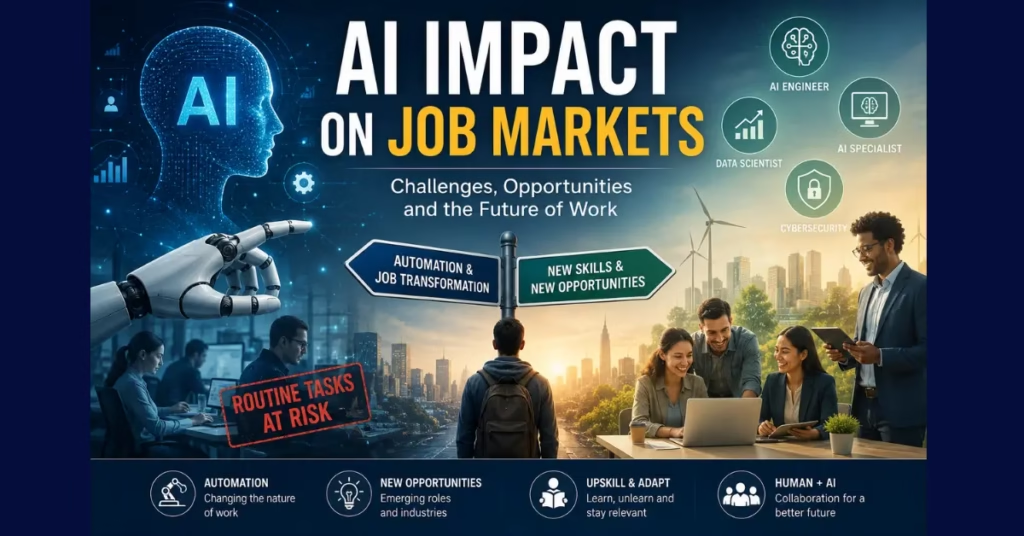
Artificial Intelligence was fast been integrated into daily life. AI is used to find information, compose emails, generate images; analyze and visualize data; translate language; write computer code.
However, when AI covers multinational emissions — as it inevitably will — one running question is becoming harder to ignore:
What will happen to our jobs?
This is a very critica question, especially for students, working people and career planning. Some worry AI will take their jobs. Some believe it will make opportunities better.
In reality, it’s somewhere in the middle.
AI impact on job markets is not only losing jobs to machines This also about the evolution of existing jobs, automation replacing repetitive tasks, as well as new careers emerging.
AI Impact on Job Markets: How Jobs Are Changing
The one caveat to recognize is that generally, AI impacts tasks before jobs.
Consider a software tester. A tester might take some time by making test scenarios, preparing test data, verifying results, writing defect reports and interacting with developers.
Several of these activities can benefit from the help of AI.
It could help to generate test ideas, produce test scenarios, sample data generation or assist in writing code automation. The tester still needs to learn the application, assess business risk, and determine if the software is truly ready for customers.
With human involvement ever present in many professions, the International Labour Organization has similarly concluded that Generative AI is not likely to displace numerous jobs, but instead causing considerable change in many industries.
This, in turn means that the real question is not: “Will AI replace my job?”
A more useful question is:
The question becomes, “how is AI going to affect the work I do today.
Which Jobs Are More Exposed to AI?
AI has a greater potential impact on work involving repetitive, predictable, and digital tasks.
Examples include:
- Data entry
- Basic administrative work
- Routine customer support
- Simple reporting
- Document processing
- Basic content creation
- Repetitive data analysis
- Some accounting activities
- Certain software testing tasks
However, this does not mean these professions will suddenly disappear.
A job may encompass a multitude of duties. It could automate some of the tasks AI while making an employee quicker and more efficient at some, says an insider.
Which is why only considering the job title gives a skewed focus.
AI Is Creating New Job Opportunities

Technology is not just killing/meeting work. This also generates new categories of work.
AI growth is influencing demand at professions in the following key areas:
- Artificial Intelligence
- Machine Learning
- Data Science
- AI Engineering
- AI Security
- AI Testing
- Data Engineering
- AI Product Management
- AI Governance
World Economic Forum’s Future of Jobs Report 2025 estimate that by the year 2030, this would lead to around 170 million net new jobs would be created worldwide and 92 million jobs displaced, for a projected net increase of approximately 78 million.
This is a crucial piece of knowledge that these statistics elucidate: the number of jobs may expand in the future, however what those jobs actually require can vary greatly.
Just because a person has lost one type of job does not mean they are eligible for another.
So, that is where learning comes in.
Why Upskilling Matters in the AI Job Market
Now picture two people who work in the same field.
One continues using traditional methods.
The other one learns how to use the AI tools and quickly starts using them to finish repetitive tasks.
The second employee might have more time for complex work, problem-solving, and decision-making eventually.
This is the reason why professionals need to consider upskilling and reskilling.
You need not become an AI scientist.
An AI-assisted research is something that a marketer can learn.
A finance person can learn AI based evaluation.
AI-assisted automation can be learned by a software tester.
A AI can be used by a business analyst to analyze requirements and documentation.
The objective is straightforward—find out how AI can help you perform better in your current profession.
Why Human Skills Still Have Value
AI is very powerful, however speed is not everything.
Even in this time, business needs people with human traits such as understanding customers, decision making from abstract information or facts and figures, solving unique problems that businesses face on a daily basis, leading a team of workforce by communicating the ideas more clearly.
Human skills like these will continue to be important:
- Critical thinking
- Communication
- Creativity
- Problem-solving
- Leadership
- Collaboration
- Adaptability
- Decision-making
In fact, as routine work is automated even further, these skills may be among the most important.
Thus, the future worker might require a blend of technical knowledge and soft skills.
What Is the Impact of AI on Software Testing Careers?
AI is already revamping Software testing process.
AI for Test case writing and is helpful to locate edge cases, test data generation, defect analysis and automation script building.
This can really hurt a manual tester who basically only does the job of iterating tests.
But there is one more opportunity available here.
Testers suffer the same fate from AI-based applications; they would spend minimal amount of time on repeatable tasks and maximum amount of time on exploratory testing, business requirements and risk analysis and quality strategy ets which an intelligence is needed.
Lately, your career trajectory is centered on a combination of testing knowhow, automation and artificial intelligence.
Same way, if you are learning software testing, you can also check the technology and this discuss resources provided as a part of SARAMBH.
What Should Students Learn for the AI Job Market?
The students of today need not fear AI coming into the job market
They must know to deal with it.
First, have a proper base in the skills of your profession. After that, study AI tools in connection to this area.
As an example, a person who wants to be doing testing might follow :
A specialization in testing: From Manual Testing to Automation Testing, then API testing and finally AI-assistive testing on data till October 2023
For example of someone interested in data might follow:
Excel → SQL → Python → Data Analysis → AI Tools
Why you shouldn (Machine Learning) (AI applications, marketing brands) You should be aware of every new AI application that finds its way onto the Internet. Whatever new tools come out over time, good underlying ideas will continue to be applicable.
Will AI Take Everyone’s Job?
Probably not.
Some others have called the AI man, will it affect a lot of people? Yes, and no.
Some repetitive tasks will disappear. Some roles may become smaller. Jobs will evolve, and we will create new work.
What may be hardest part of this is the AI. Maybe the absence or refusal to evolve.
Now is the time to leap and pounce into whimsical opportunities for lifelong learners.
AI Wizard Overnight with use One tool that helps you Getting started You don t need to go from 0-100 on being an Ai wizard overnight Try it on a real problem. Check its results. Understand its limitations. Then continue learning.
Conclusion
The AI will be the war machine, but your future — and it has to be together with us, not humans against machines.
We have the machine or AI that can automate a lot of the routine tasks but they are not there to substitute supervision, creativity, experience and empathy (yes! — and no amount of human judgement and accountability will ever change that!
In an accelerated workplace, the ultimate winners probably will be professionals who apply their current knowledge with AI.
Technology will continue to evolve.
you dont just need to learn a tool, you need to grow That will be the most universally useful of the all skill that can lead to an AI age career
It is both an ability and a desire to keep learning.
FAQs
1. Will AI replace human jobs?
AI also automises certain functions and reduces demand for some roles, but a number of tasks are more likely to evolve than vanish.
2. What jobs are at risk from AI?
The level of exposure to AI automation for jobs with repetitive, predictable and digital tasks is much higher.
3. Will AI create new jobs?
Yes. AI is creates opportunities in the fields including machine learning, AI engineering, data science, AI testing and AI security.
4. Top really important skills that you should learn for the future
Study AI literacy along with all other skills relevant for your profession. Other micro skills are Critical thinking, Communication Skills, Problem solving and Adaptability.
5. Should software testers learn AI?
Yes. Artificial intelligence(∞AI) for Software Testing helps Testers on different activities like test-case generation, automation and Defect analysis also test data.
External Resources
- World Economic Forum – Future of Jobs Report 2025
- International Labour Organization – Generative AI and Jobs
More information


Clair et pratique. Essayez Muse Voice Transcribe : . Muse Voice Transcribe
Hello,📘 New Book: Software Testing – The Complete Guide
From “what is testing?” to acing your QA interview — 245 pages, real project examples, 100+ interview questions, zero fluff.
Perfect for freshers, career switchers & junior testers.
Grab your copy 👇
https://sarambhi.gumroad.com/l/SoftwareTesting